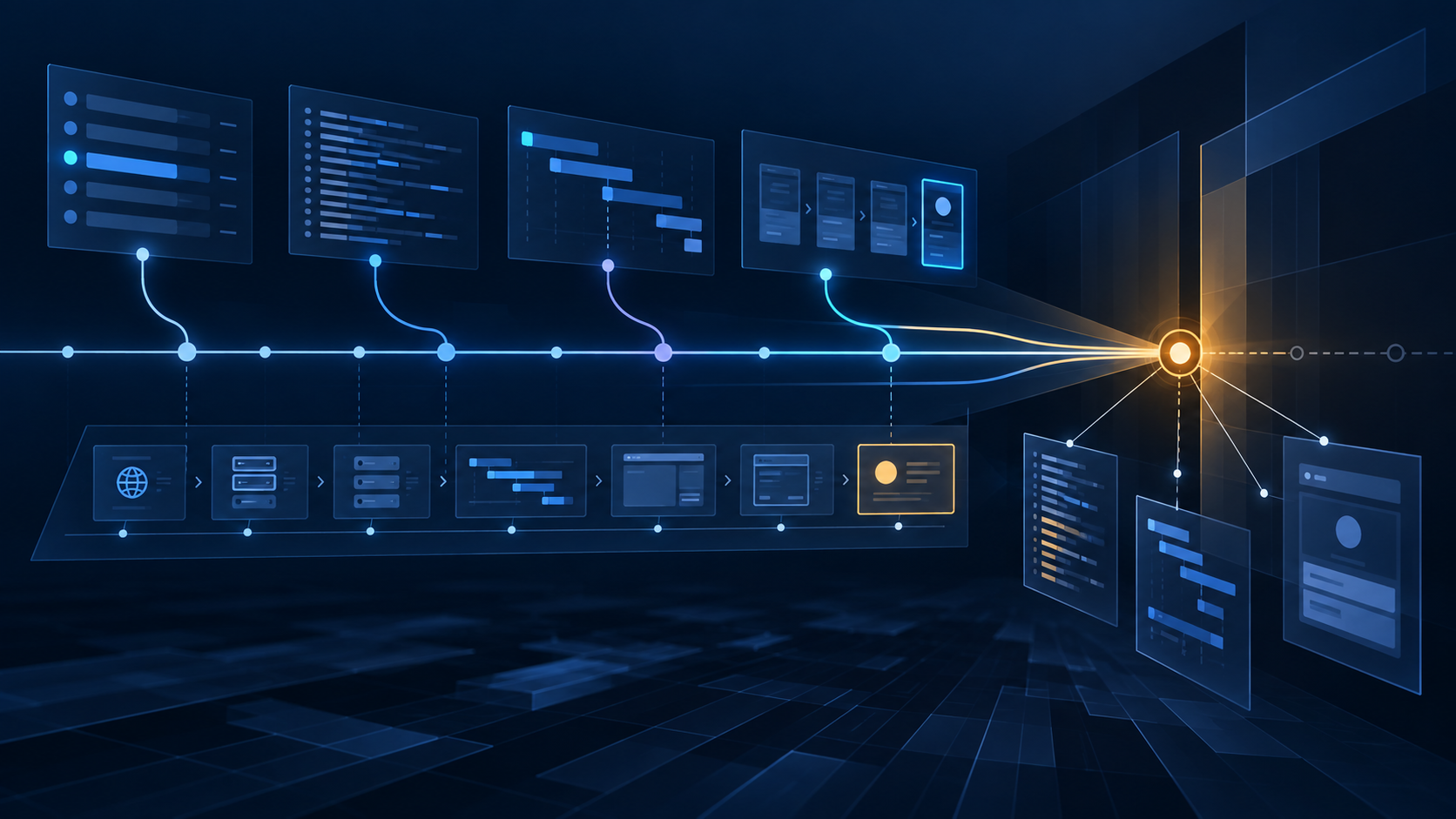
Production Debugging: Stop Guessing and Start Reconstructing
There is a particular kind of bug every engineer eventually meets.
It works locally.
It works in QA.
It worked yesterday.
Then a user does something completely reasonable in production and everything falls apart.
Those bugs are frustrating because the obvious debugging tools often aren't enough.
You cannot simply sit beside the user and refresh the page ten times.
You have to reconstruct what happened.
That is where production debugging becomes less about writing code and more about investigation.
Console logs are not an observability strategy
I love console.log.
Almost every developer does.
It is fast.
It answers questions.
And during local development, it is incredibly useful.
But production systems need more.
Once an application becomes complex, you need to understand events across time.
What did the user do before the failure?
What request was sent?
What response came back?
What state did the UI have?
Was the failure frontend, backend, network, authentication, or some strange interaction between them?
That requires structured logging and observability.
Reconstruct the sequence
When debugging complicated production issues, I try not to start with:
“What code is wrong?”
I start with:
“What sequence of events produced this state?”
That change in mindset matters.
Many frontend bugs are state-transition bugs.
The individual functions may be correct.
The problem happens because they execute in an unexpected order.
Maybe an API request finishes after the user navigates away.
Maybe stale data overwrites newer state.
Maybe the UI retries something the backend has already processed.
Maybe two components believe they own the same piece of state.
The bug lives between events.
So reconstruct the timeline.
Start with evidence
Before changing code, gather evidence.
Network requests.
Logs.
Error traces.
User actions.
Application state.
Backend responses.
Timestamps.
This prevents the classic mistake of fixing the thing we think is happening instead of the thing that is actually happening.
Production debugging rewards skepticism.
Assume nothing.
Verify everything.
Error handling should tell a story
Good systems don't simply report that something failed.
They provide enough information to understand the failure.
Frontend applications should have meaningful error boundaries.
API failures should be identifiable.
Critical actions should carry enough context to trace what happened.
Logs should answer questions instead of creating more questions.
The goal isn't to log everything.
That creates noise.
The goal is to log the information you would desperately wish you had while investigating an incident at 2 a.m.
Don't waste the incident
One of the biggest differences between mature and immature engineering teams is what happens after the bug is fixed.
Immature teams celebrate that production is working again and immediately move on.
Mature teams ask:
Why was this possible?
Why didn't we detect it earlier?
What architectural assumption failed?
What test should exist now?
What monitoring should exist now?
Do we need to change the component, API contract, deployment process, or documentation?
That is where debugging turns into engineering improvement.
The bug becomes information.
Production engineering is a mindset
Shipping software is not the final step.
Operating software is part of the job.
Senior engineers eventually learn that writing the feature may be the easy part.
Understanding what happens when the assumptions behind that feature collide with real users, real networks, real data, and real systems is where things become interesting.
So the next time production breaks, resist the urge to immediately start changing code.
First reconstruct the story.
Because most difficult bugs are telling you something.
You just have to listen carefully enough.